





Pemerintah Kabupaten Aceh Tamiang: Bumi Muda Sedia Pulih dan Bangkit
Pemerintah Kabupaten Aceh Tamiang: Bumi Muda Sedia Pulih dan Bangkit — Informasi Terbaru
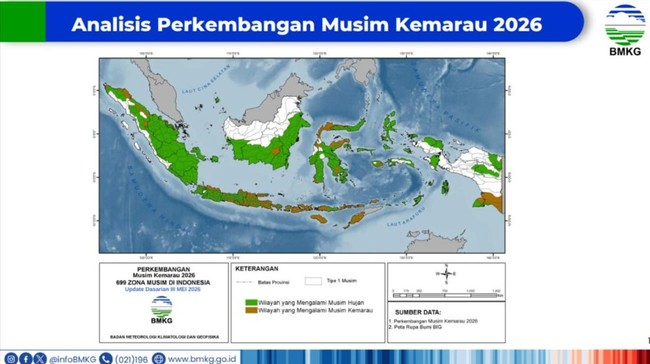
In a recent analysis, the Indonesian Meteorology, Climatology, and Geophysics Agency (BMKG) released new information about the country's dry season and El Nino phenomenon.
According to BMKG, the Dasarian III May 2026 monitoring results showed an IOD index of -0.92 (-0.56) and an ENSO index of +1.04 (+1.00), indicating an El Nino condition. BMKG reminded that there is a less than 20% chance of El Nino developing into a strong category.
BMKG elaborated that the El Nino-Southern Oscillation (ENSO) is an anomaly of surface sea temperature in the Pacific Ocean off the coast of Ecuador and Peru, which is higher than the normal average.
During the El Nino phase, the trade winds, which usually blow from east to west, weaken or even reverse direction. This weakening is linked to the expansion of warm sea surface temperature in the central and eastern Pacific. The warm water, which shifts to the east, causes evaporation, clouds, and precipitation to move away from Indonesia. This results in an increased risk of drought.
BMKG clarified that, in current climate science, El Nino indicates positive temperature anomalies in the eastern equatorial Pacific, while negative anomalies occur in the western Pacific and Indonesian waters. When El Nino occurs, cloud formation areas shift towards the central Pacific, resulting in reduced rainfall in Indonesia.
This implies that El Nino, particularly when it occurs during the dry season, requires attention due to its significant impact on rainfall levels. BMKG warned that its effects may trigger potential disasters, such as drought and landfires. Prolonged droughts will ultimately affect agriculture, the economy, and social aspects.
BMKG also released a warning that, despite the latest predictions, no region is currently in the "Siaga" or "Awas" categories for severe meteorological drought.
However, areas in Nusa Tenggara Barat (NTB) are at a "Waspada" level and will remain so until the end of the first Dasarian of June 2026.
BMKG reported that 28.6% of Indonesia's territory (200 ZOM) is now experiencing the dry season.
BMKG stated that regions experiencing the dry season include a small part of Aceh, a small part of Sumatra Utara, a small part of Riau, a small part of Riau Islands, northern Banten, northern Jakarta, northern Jawa Barat, central Jawa Tengah, eastern Jawa Timur, a small part of Bali, a small part of NTB, most of NTT, a small part of Gorontalo, central Sulawesi, a small part of Sulawesi Barat, eastern Sulawesi, eastern Sulawesi, a small part of Maluku, and a part of Papua Selatan.
Similarly, areas expected to enter the dry season during Dasarian I-III of June 2026 include most of Pulau Sumatra, Banten, southern Jakarta, central Jawa Barat, southern Jawa Timur, western Kalimantan, central Kalimantan, southern Kalimantan, eastern Kalimantan, most of Sulawesi Utara, a small part of Sulawesi Barat, eastern Sulawesi, a small part of Sulawesi Tenggara, eastern Maluku, western Papua, eastern Papua, and a small part of Papua Selatan.
BMKG also forecasted that the peak of Indonesia's dry season will vary across different regions, with some areas having already experienced their peak in Dasarian I, while others are expected to peak in January 2027.
BMKG further added that, according to a presented map, most Indonesian regions will likely experience their dry season peak in July-August of this year.
Latest updates on El Nino and Indonesia's dry season, including the peak months and potential impact on the country.
Pemerintah Kabupaten Aceh Tamiang: Bumi Muda Sedia Pulih dan Bangkit — Informasi Terbaru

Acara 600 ribu porsi kulinier gratis di Monas, menghidupkan semangat kebangsaan dan memperkuat rasa...

Hayden Panettiere, bintang televisi Amerika yang terkenal dengan perannya dalam serial 'Heroes' dan...
Jalan Merdeka Barat Dekat Istana Merdeka Jadi Parkir Liar Warga yang ke Monumen Nasional IDN Times

Kopassus Mengudara: Aksi Terjun Payung Terunggul di Istana Merdeka - Media Indonesia

Watch the live action of Tijuana vs. Cruz Azul, all the latest news, analysis, and match scores...

Netizen tidak senang dengan komentar-komentar yang diberikan

BTS mungkin kembali mengikuti Grammy setelah rekanan mereka, Recording Academy, mengumumkan revisi...
BTS mungkin tidak akan mengubah keputusan untuk mengabaikan Grammy karena deadline pengiriman musik...
Update terbaru tentang keputusan BTS untuk tidak mengirimkan musik mereka untuk dijadikan nominee...
Pihak Recording Academy mengumumkan akan kembali meninju keputusan untuk memperkenalkan kategori...

Sangyeop Sangyeop mengumumkan rencananya untuk menikah dengan seorang non-celebrity, mengejutkan...