



The Independence of the US Department of Justice: Todd Blanche's Uncertain Pledge
The Importance of an Independent US Department of Justice: Understanding Todd Blanche's Remarks
The statement highlights the tense situation surrounding the Strait of Hormuz, which has been under strict restrictions following a prolonged conflict involving Iran, Israel, and the United States.
The critical shipping lane, which serves as the primary route for global oil exports, has effectively been closed to most commercial traffic since the Iranian Revolutionary Guard Corps began targeting vessels in response to US and Israeli attacks.
Tensions escalated further in April when Iran announced a $2 million fee for ships passing through the strait, prompting the formation of the Persian Gulf Strait Authority to manage the toll.
However, the US imposed sanctions on the organization, further heightening uncertainty for the shipping industry.
Currently, only a small number of vessels flying the flags of African countries are allowed to pass through the strait, while others are rejected or even reported to be trapped in the region.
Greek ship owner Evangelos Marinakis has a different perspective, suggesting that paying for passage through the strait is a more cost-effective option than navigating around Africa.
This viewpoint differs from some major shipping companies and industry players, who believe that the international shipping lane should remain open without additional tolls.
Companies such as Chevron and Mitsui OSK Lines oppose the implementation of transit fees due to concerns that it may set a precedent for similar tariffs on other critical marine routes.
Ahead of the Potential Reopening of the Strait
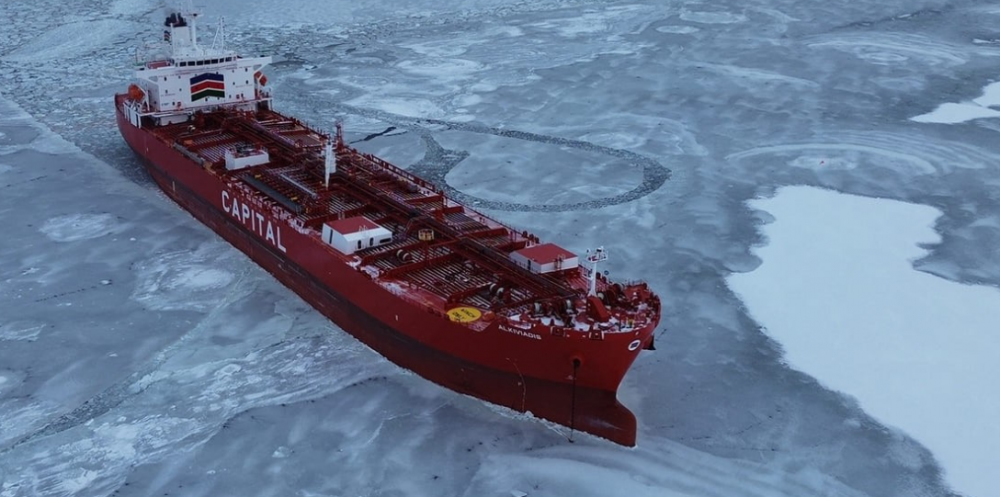
In light of the uncertainty, Marinakis says that Capital Maritime has positioned some of its vessels near the Gulf region in anticipation of a potential peace agreement and the resumption of normal shipping activity.
“We have many ships operating in the region near the Arabian Gulf. We pay lower tariffs to position our fleet within three to five days of the area,” he explains.
He adds that some vessels are stationed in India, others in East Africa, and some in the vicinity of Singapore, with all of them located within three to ten days of the Gulf region.
According to Marinakis, this strategy enables his company to respond quickly if a peace agreement is reached and trade activity resumes.
“If a peace agreement is achieved and cargo flows are restored, we'll be in the right position. That's the best we can do,” he adds.
Pantau pergerakan pemegang saham dengan kepemilikan 1%+ di perusahaan publik secara mudah.
Greek Ship Owner: Paying for Hormuz Suez Canal Alternative Costs Less



The Importance of an Independent US Department of Justice: Understanding Todd Blanche's Remarks
Donald Trump orders Pentagon to scale back joint military exercises with South Korea, citing his...
Representative Nancy Mace embarks on a new journey, unveiling her full sleeves of long-concealed...
The decision to cut back on military drills with South Korea has significant implications for...

FITSNews reports on Nancy Mace's transition from outgoing congresswoman to online talk show host,...
Trump directs Hegseth to scale back joint military exercises with South Korea Politico

Netizen tidak senang dengan komentar-komentar yang diberikan

BTS mungkin kembali mengikuti Grammy setelah rekanan mereka, Recording Academy, mengumumkan revisi...
BTS mungkin tidak akan mengubah keputusan untuk mengabaikan Grammy karena deadline pengiriman musik...
Update terbaru tentang keputusan BTS untuk tidak mengirimkan musik mereka untuk dijadikan nominee...
Pihak Recording Academy mengumumkan akan kembali meninju keputusan untuk memperkenalkan kategori...

Sangyeop Sangyeop mengumumkan rencananya untuk menikah dengan seorang non-celebrity, mengejutkan...